
On the DSO's map, 21 of Cyprus's 52 areas are congested, so new solar there may not be able to export.
The map from EAC's Distribution System Operator (DSO) shows that in 21 of Cyprus's 52 areas, the grid has no room left for new solar. If you live or work in one of them, your new panels may only be allowed to connect with permanent zero export, so they would never send power to the grid. That cuts what you save, and makes a battery far more useful.
What a congested area is, and what permanent zero export means
We call an area congested when the grid can't take any more power from solar. The congestion can be at the transmission substation that serves the area, or more locally, in the distribution network of your neighbourhood.1 In a congested area, the DSO allows new solar only with permanent zero export. The rule has no size limit, so it covers a small system on a house roof too.2
Permanent zero export means you never send power to the grid, from the solar or from the battery.3 An export limitation system, set permanently to zero, makes sure of it. Permanent zero export doesn't change later, and you can't go back to a standard connection or to occasional zero export.1, 4
The DSO's map
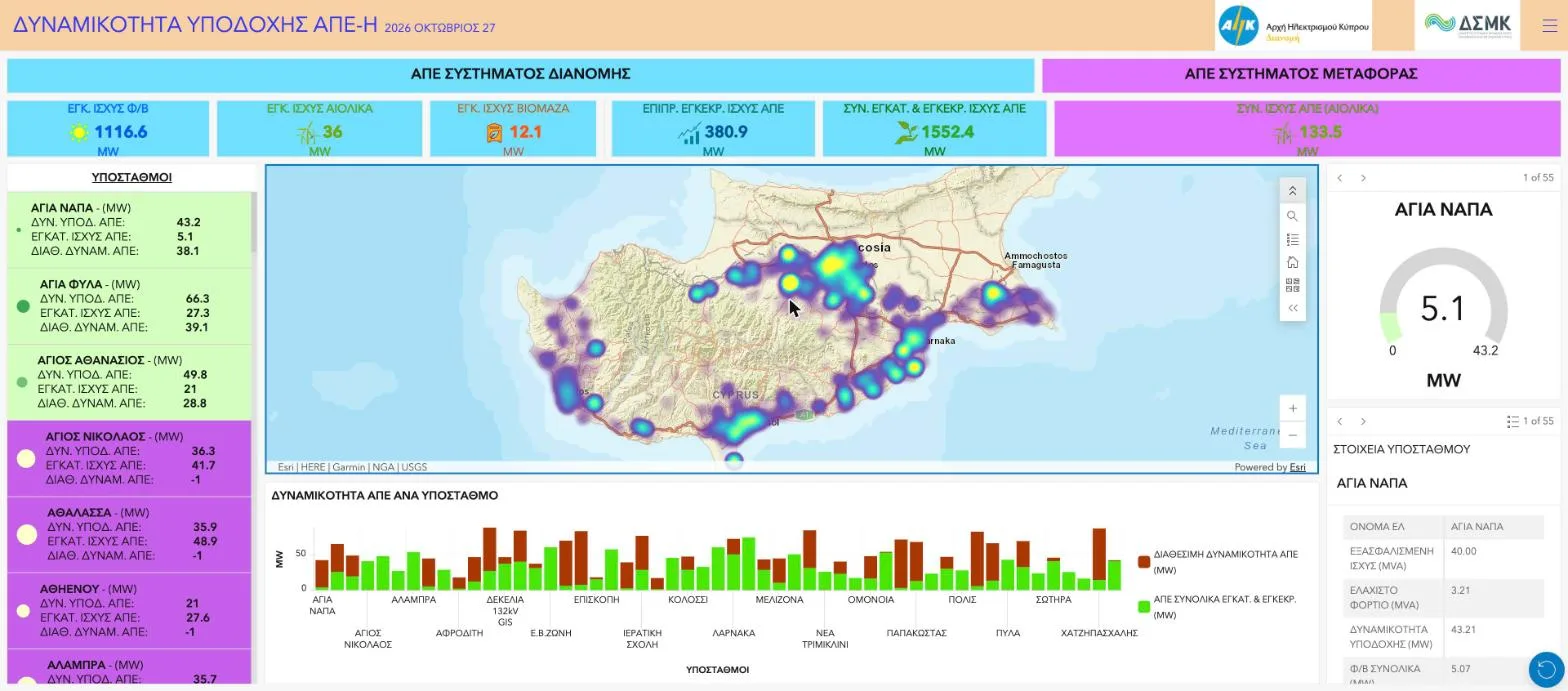
The DSO and the Transmission System Operator of Cyprus (TSOC) publish the RES hosting capacity map. For each transmission substation, the map shows how many MW of renewables the grid can take and how many are already installed or approved. The difference is the available capacity.5 The map's figures are from 27 October 2026, and the DSO doesn't say when it will update them.
The map is indicative. The DSO's connection guide says the congested areas are shown there "indicatively", and the DSO assesses every application on its own.2, 5 Because congestion can also be local, an area with free capacity on the map can have a congested network in your own neighbourhood. You only get the final answer when you apply. If the DSO then gives you permanent zero export terms, the law requires it to justify them with a documented study.6
The DSO's RES hosting capacity map
The areas today
Of the 55 transmission substations, 21 serve an area and have no free capacity. Eight are in Nicosia district, five in the Larnaca and Famagusta area, and four each in Limassol and Paphos.5 There is still plenty of room in the town centres of Nicosia, Limassol, Larnaca and New Paphos, and in Protaras.
| Substation (capacity) | Main areas served | How full |
|---|---|---|
| Nicosia | ||
| Alambra (40.4 MW) | Dali (part), Lythrodontas, Lympia, Agia Varvara, Kornos, Alampra | 100% |
| Athalassa (40.2 MW) | Geri, Aglantzia, Pyroi (part) | 100% |
| Ergates (47.5 MW) | Psimolofou, Ergates, Klirou, Arediou, Pera Oreinis, Kalo Chorio Oreinis | 100% |
| Kokkinotrimithia (39.8 MW) | Palaiometocho, Kokkinotrimithia, Agioi Trimithias, Mammari | 100% |
| Lakatamia (50.4 MW) | Lakatamia, Anthoupoli, Tseri (part), Pano Deftera, Kato Deftera | 100% |
| Latsia (54.0 MW) | Latsia (part), Tseri (part), Geri (part), Dali (part), Nisou | 100% |
| Orounda (64.0 MW) | Akaki, Astromeritis, Peristerona, Meniko, Mitsero, Orounta | 100% |
| Tembria (25.7 MW) | Kakopetria, Evrychou, Korakou, Kalopanagiotis, Kampos, Pedoulas | 100% |
| Strovolos (70.5 MW) | Strovolos, Chryseleousa, Lakatamia (part), Latsia (part) | 49% |
| Seminary (78.1 MW) | Engomi, Archangelos, Makedonitissa, Chryseleousa (part), Lakatamia (part) | 39% |
| Dasoupoli (90.4 MW) | Dasoupoli, Agios Dimitrios (Strovolos), Apostolos Varnavas (Strovolos), Latsia (part), Plati (Aglantzia) | 32% |
| Papacostas (69.3 MW) | Kaimakli, Taht-el-Kale, Chrysaliniotissa, Agios Kassianos, Aglantzia (part) | 20% |
| Karvounas (17.4 MW) | Kyperounta, Pelendri, Agros, Agios Ioannis (Pitsilia), Amiantos, Prodromos | 15% |
| District Office (84.8 MW) | Lykavittos, Pallouriotissa, Agios Antonios, Agioi Omologites (part), Akropoli, Aglantzia (part) | 10% |
| Prentzas (84.0 MW) | Agios Dometios, Agios Andreas, Trypiotis, Agios Pavlos, Faneromeni, Agioi Omologites (part) | 8% |
| Limassol | ||
| Moni (50.5 MW) | Parekklisia, Pyrgos, Moni, Monagroulli, Pentakomo, Asgata | 100% |
| Nea Trimiklini (20.6 MW) | Platres, Pachna, Omodos, Trimiklini, Lania, Kalo Chorio (Limassol) | 100% |
| Pissouri (20.0 MW) | Pissouri, Avdimou, Anogyra, Prastio Avdimou, Alektora, Pachna (part) | 100% |
| Ypsonas (14.2 MW) | Ypsonas (part), Palodeia, Kyvides, Souni-Zanatzia, Paramytha, Apesia | 100% |
| Episkopi (18.4 MW) | Episkopi, Kantou, Sotira (Limassol), Souni-Zanatzia (part), Episkopi Cantonment (British base) | 91% |
| Polemidia (47.8 MW) | Kato Polemidia (part), Ypsonas, Agios Spyridonas, Anthoupoli (Limassol), Tserkezoi, Pano Polemidia (part) | 67% |
| Kolossi (48.2 MW) | Kolossi, Trachoni, Erimi (part), Akrotiri, Asomatos | 63% |
| Agios Athanasios (49.8 MW) | Agios Athanasios, Mesa Geitonia (part), Neapoli, Chalkoutsa, Panthea, Germasogeia (part) | 42% |
| Agia Fyla (66.3 MW) | Agia Fyla, Kapsalos, Kontovathkia, Mesa Geitonia (part), Fasoula, Pano Polemidia | 41% |
| Omonia (48.9 MW) | Omonoia, Apostolon Petrou kai Pavlou, Apostolos Andreas, Agios Ioannis, Tsiflikoudia, Kato Polemidia (part) | 37% |
| Germasogeia (47.5 MW) | Germasogeia, Agia Paraskevi, Akrounta, Foinikaria, Armenochori, Agios Athanasios (part) | 28% |
| Amathus (45.6 MW) | Agios Tychonas, Mouttagiaka, Armenochori (part) | 14% |
| Zakaki (40.0 MW) | Zakaki (Limassol) | 9% |
| Old Power Station (72.8 MW) | Limassol historic centre, Old Port and Marina, Katholiki, Arnaoutogeitonia, Tzami Tzentit, Agia Triada | 6% |
| Larnaca and Famagusta | ||
| Agios Nikolaos (41.1 MW) | Avgorou, Frenaros, Liopetri (part), Agios Georgios Acheritou, Dasaki Achnas (part), Deryneia (part) | 100% |
| Athienou (26.0 MW) | Athienou, Troulloi, Avdellero | 100% |
| Free Industrial Zone (48.5 MW) | Aradippou (part), Dromolaxia (part), Kalo Chorio (Larnaca), Tersefanou, Psevdas, Alethriko | 100% |
| Kofinou (33.5 MW) | Kofinou, Pano Lefkara, Anglisides, Mazotos, Agios Theodoros, Choirokoitia | 100% |
| Pyla (43.4 MW) | Oroklini, Pyla, Kellia (part) | 100% |
| Sotira (46.6 MW) | Sotira, Liopetri (part), Xylofagou (part), Ayia Napa (part), Agia Thekla | 92% |
| Dhekelia (47.5 MW) | Xylofagou, Xylotymvou, Ormideia, Dasaki Achnas, Dhekelia (British base) | 82% |
| Larnaca (73.8 MW) | Aradippou, Livadia, Agios Nikolaos (Larnaca), Kamares, Kellia | 71% |
| Mari (44.2 MW) | Kalavasos, Maroni, Zygi, Tochni, Choirokoitia (part), Mari | 68% |
| Vasilikos South (41.1 MW) | Vasilikos area, Mari (part), Pentakomo (part), Governor's Beach | 60% |
| International Airport (85.6 MW) | Larnaca (Mackenzie, airport), Dromolaxia-Meneou, Kiti, Pervolia | 49% |
| Melizona (45.6 MW) | Paralimni (centre), Deryneia, Kapparis | 26% |
| Protaras (67.4 MW) | Protaras, Paralimni (part), Ayia Napa (part) | 22% |
| Ayia Napa (43.2 MW) | Ayia Napa (centre), Cape Greco | 12% |
| Larnaca Commercial Centre (71.1 MW) | Larnaca centre (Finikoudes), Chrysopolitissa, Skala, Agioi Anargyroi II, Livadia (part) | 10% |
| Alexigros | No service area shown on the map | no figure |
| Psevdas | No service area shown on the map | no figure |
| Paphos | ||
| Anatoliko (20.9 MW) | Timi, Acheleia, Agia Marinouda, Koloni, Amargeti, Pano Panagia | 100% |
| Polis (23.9 MW) | Polis Chrysochous, Argaka, Kato Pyrgos, Agia Marina Chrysochous, Neo Chorio, Pomos | 100% |
| Stroumbi (17.7 MW) | Tsada, Polemi, Giolou, Stroumpi, Koili, Letymvou | 100% |
| Xeropotamos (17.1 MW) | Mandria, Anarita, Timi (part), Nikokleia, Souskiou, Mamonia | 100% |
| Akoursos Road (38.1 MW) | Peyia, Tala, Kissonerga, Kathikas, Ineia, Drouseia | 86% |
| New Paphos (86.0 MW) | Paphos (centre, Anavargos), Geroskipou, Chloraka, Empa, Konia, Mesogi | 38% |
| Aphrodite (18.3 MW) | Kouklia, Aphrodite Hills, Mandria (part) | 18% |
| Hadjipaschalis (88.6 MW) | Kato Paphos, Paphos harbour, Geroskipou (part), Chloraka (part) | 18% |
| Orites | No service area shown on the map | no figure |
The 55 transmission substations, with the figures from the RES hosting capacity map of 27 October 2026. How full shows how much of each substation's capacity is already taken by installed and approved systems. In red are the 21 that are full (100%), and in green the 10 that are less than 20% full. The areas served are approximate and come from the boundaries the map shows for each substation (May 2024). "(part)" means the community is split between two substations. Psevdas, Alexigros and Orites have no service area on the map.
How much a home saves in a congested area
With permanent zero export and no battery, the panels produce only what you use at that moment. We calculated that a home in Nicosia that uses most of its power in the evening loses more than half the energy its panels could produce, and saves €469 a year. With a 5 kWh battery it saves €849 a year, but at today's battery prices you do not earn back what the battery costs within 15 years.
What you save with solar in a congested area, with a battery or without →
See what you would save with solar and a battery. Try our calculator. It takes less than a minute.What applies to businesses
In a congested area, a business too connects new solar only with permanent zero export.2 How much output it loses depends mainly on when it uses power. An office, a shop or a workshop that runs during the day uses much of its output as it's produced, and loses little. A restaurant that works mostly in the evening loses much more, so a battery helps it more. The kW limits for each fuse size are in our article on business solar.
What to do if your area is congested
First find your substation on the map or in the table above. If it's congested, size the system to what you use during the day. Also decide from the start whether you will add a battery, because adding one later needs a new application to the DSO. And if you already have solar and want to add panels, you again need a new application and the DSO's approval.2
Our calculator shows what you would save, with a battery or without.
For your home For your business
Keep reading
If you install solar without a battery in a congested area, you may lose more than half of its output.
In a congested area, new solar usually connects only if it never sends energy to the grid. In the example we worked out, a home without a battery loses 53.6% of its output. See how much the same home saves with a battery.
SolarIf your solar panels send energy to the grid, a battery does not save you more today.
If your solar panels send energy to the grid, under EAC's current Net Billing contract a battery does not save you more. See the calculator's figures and when a battery is worth considering.
SolarWith occasional zero export, you can use the power from your solar panels on curtailment days too.
With occasional zero export, a curtailment first stops only your export, and your home can keep using its own solar. You apply in writing to EAC's DSO and pay for the equipment; the DSO can still cut production off.
References
- EAC's DSO, Technical guide for RES systems up to 15 MWp, edition 2026.1, 15 May 2026, section 6.3.3.5. EAC (PDF, in Greek)
- EAC's DSO, Connection guide for active customers and self-consumers, 15 May 2026, section 4.1. EAC (PDF, in Greek)
- EAC's DSO, Technical guide for connecting storage systems, edition 2026.3, 15 July 2026, section 2. EAC (PDF, in Greek)
- EAC's DSO, Occasional zero export operation, 2025. EAC (PDF, in Greek)
- EAC's DSO and TSOC, RES hosting capacity map, figures of 27 October 2026. EAC (map, in Greek)
- Electricity Market (Amendment) Law 70(I)/2026, section 5(b), which adds paragraph (c) to Article 47(3A). CyLaw (PDF, in Greek)
- EAC Supply, net billing contract (version 6, August 2026), clause 7.1. EAC (in Greek)
Share
This article is provided for information only and is not financial or legal advice. The rules and the map's figures come from the publications of EAC's DSO and TSOC and may change. The amounts are estimates from our calculator and your own result will differ. Switch is not responsible for decisions made in reliance on it.